When Will the World Be Like the 60s Again
There's little dubiety that the 1960s was a decade that changed the nation. What started out as an age of hopeful innocence grew into a time of rage and violence.
"At the outset of the 1960s, people felt great confidence and expectations. The state was riding a wave of prosperity of the like that had never been seen before," said Michael Flamm, professor of history, Ohio Wesleyan University, and writer of "In the Oestrus of the Summer: The New York Riots of 1964 and the War on Crime."
"A hallmark (of the '60s) was that the prosperity was shared" across society "similar never before," said Michael Kazin, professor of history, Georgetown Academy, and editor of Dissent magazine.
America may have been the richest state ever, merely by the mid-'60s our sense of security was breaking down, first in urban areas simply then spreading to the suburbs and rural areas, Flamm said.
Then equally now, our impression of America was created by what we saw in popular culture, highlighted by the idyllic representations depicted on 1950s television shows like "Leave It To Beaver," said Joel Rhodes, professor in the history section of Southeast Missouri State Academy. The happy families on Telly did not accurately evidence the division that was already segmenting America in the '50s, said Rhodes, who believes "the Vietnam era" is a more appropriate term when discussing Americans' growing loss of security during the decade.
While "the '60s are often remembered every bit a time of radicalism, it's of import to remember that on Jan. ane, 1960, the world didn't wake up radical. The early 1960s looked more like what we collectively associate with the '50s than that '60s countercultural image," said Natalia Mehlman Petrzela, a historian of gimmicky American politics and civilisation and host of the Past, Nowadays Podcast.
No. 1 threat
The cease of Earth State of war Two saw a brief menses of euphoria, just we before long became a fearful nation, Rhodes said. People contemplated, "what if Pearl Harbor had been a nuclear assail?"
"E'er since the finish of World War 2, American never gets out of the shadow of war. We're either preparing for war or fighting a war," Rhodes said.
The regime tried to build confidence through civil-defense measures, but the idea that a nuclear assail would exist survivable by building a bunker or hiding nether a school desk terrified people, Rhodes said.
"If y'all think of fear every bit layers of an onion peel, the No. one fear is nuclear war," Rhodes said. The 13-day Cuban Missile Crisis in October 1962 brought home the fact that our nation was vulnerable to nuclear disaster, he added.
Assassinations
In the White House, the Kennedys were America's glamorous first couple, not only representing promise for the future but fighting for it, likewise.
"The assassination of JFK led to uncertainty. What'due south going to happen to our country?" Rhodes said.
The assassination was the showtime major national event played out on television, and as the images flashed over and over again, people thought, "If the president was vulnerable to assail, aren't we all?"
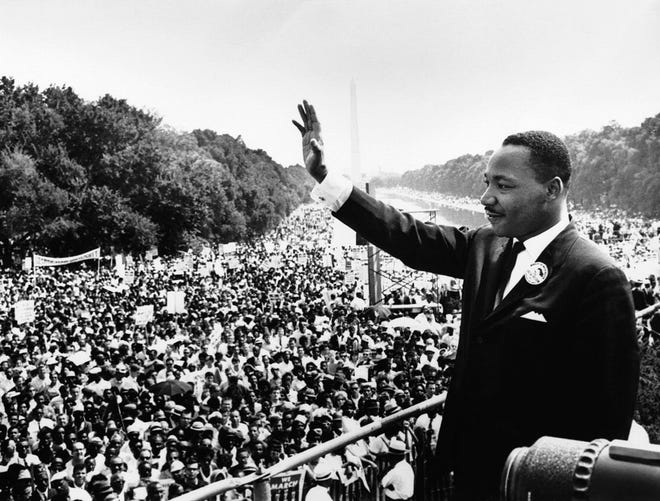
Two more high-profile assassinations followed. Ceremonious rights leader Martin Luther King Jr. was shot and killed by a sniper'due south bullet Apr 4, 1968, and presidential candidate Robert F. Kennedy, blood brother of President Kennedy, was fatally shot June 5, 1968, afterward winning the California presidential master.
"Losing JFK, and and so after RFK and MLK, were individually tragic events, but I remember that with each of them, it is important to see that the violence of these tragic acts chipped away at what might have felt like a shared sense of purpose or religion in 'working inside the organization' to redress inequality," Mehlman Petrzela said. "If each of these figures, nearly notably the president, could be so brazenly and violently silenced, what was the bespeak of playing by the rules? It definitely shook people's sense of faith in those rules every bit worth following (or) a guarantee of their own safe and civic and bodily well-being."
The events of this era, "for different reasons, made those on both the right and the left question their safe," Mehlman Petrzela said. "Liberals saw their reformist heroes assassinated — fifty-fifty someone similar MLK whose platform had been explicitly nonviolence — and a violent state of war unfolding in Vietnam, whereas conservatives were repelled by a culture that seemed to take transformed innocent students into 'campus radicals,' giving rise to a call for 'police force and order.'"
Protest, rage and social change
The non-violent protests of the Ceremonious Rights motility in the South ready the stage for the student movement of the 1960s, Rhodes said. For middle-class Americans it seemed as if revolution was at hand. Young people fought for their gratuitous spoken language, protested Vietnam, and took over and even burned campus buildings.
"The common working-grade American just didn't sympathise. Why are these kids who accept the privilege to go to higher and come from good homes disrespecting authority? Why are they burning their draft cards? It was inexplicable" to many people, Rhodes said. "What's happening to the values and traditions we concur honey? It made parents concerned what would happen to their younger children, too."
The baby boomers represented a huge demographic.
"Over one-half of the U.S. population was nether 30 past the mid '60s. Even if a small number of them were rebelling, it seemed that guild equally a whole was rebelling," Flamm said.
It wasn't just on higher campuses. Everywhere men started wearing their hair long and younger people began to dress differently. The drug civilisation and the women's movement were going mainstream, as well, Flamm said.
While people accept always institute comfort and security in marriage, during the '60s divorce skyrocketed, Rhodes said. Single families and blended families increased. Women demanded equality, and mothers joined the workforce in greater numbers.
"Yep, groups similar the Black Panthers were scary to some people, only heck, women, women in the suburbs were getting jobs and not staying at habitation and that was scary," Rhodes said.
"Every time there is change — and in that location's radical change in the '60s — in that location'due south fearful reaction," he said.
A flood of violence
The 1950s are often seen as a golden age with stable families, a plentiful economic system and depression crime rates. The mid-1960s ushered in a wave of violence, law-breaking and urban riots.
America didn't only experience more dangerous, it was more dangerous. The tearing law-breaking charge per unit increased by 126 percent betwixt 1960 and 1970, according to the Brennan Center for Justice. An American's chances of beingness murdered was relatively low in the '50s and early '60s merely doubled between 1964 and 1974.
"Beginning in 1964-1965, every summer the nation's ghettos erupt in violence. At that place are over 300 riots in the late '60s," Rhodes said.
"Every major metropolis experiences a riot or rebellion," Flamm agreed.
"This mixes seamlessly with the campus riots, the rise of radical militant groups like the Black Panthers. There'due south a sense that the nation is at war with itself," Rhodes said.
Economic insecurity
Insecurity really hits habitation when it hits your wallet. By the 1960s Americans had embraced economic security and the ability to buy a home and go on a yearly vacation.
"The '60s were a prosperous fourth dimension in general, just we showtime to see a decline outset in the macro towns so in other areas similar the Rust Belt," Kazin said. "There was a fright of economic decline. Manufacturing was doing well, merely the heyday was over."
Industrially, countries like Nippon and Germany were on the rise.
"The thing about insecurity is that when y'all start to feel insecure in i role of your life it tends to spread to other parts," Kazin said.


Source: https://www.sj-r.com/story/lifestyle/2017/05/25/from-hope-to-fear-1960s/20784667007/
0 Response to "When Will the World Be Like the 60s Again"
Post a Comment